When miniaturizing the NERD 2 product, we changed to a smaller
pressure sensor module. Unfortunately, some units are exhibiting shifts of up
to 50 mbar under certain environmental conditions.
While the units are able to meet relative depth accuracy
requirements as per EN 13319, Shearwater feels that absolute accuracy is
important for PPO2 reporting and decompression calculations.
What is Shearwater doing about this?
Shearwater is redesigning the NERD 2 to use the pressure
sensor with which we have more than 10 years of successful experience.
Production and new sales will be suspended until improved parts are
available. All existing NERD 2 customers are being offered the update to the
new parts at no charge.
Can I continue to use my NERD 2?
This problem is variable in nature and some users will not be
affected. Determine if your
NERD 2 is affected using the information below.
You may continue to use your NERD 2 if you are
comfortable with the level of error in the absolute accuracy. However, we
still recommend that all users return their NERD 2s to be reworked.
What should I do?
We expect the solution to be ready for the rework to begin in
May. We felt it important to raise awareness before the solution was
ready. Please contact Shearwater at info@shearwater.com if
you have a NERD 2 and we will direct you to the nearest service center for
rework.
We apologize for the frustration you are feeling.
Determining If your NERD 2 is affected
All NERD 2 units are factory calibrated when shipped from
Shearwater. However, the problem with some NERD 2 pressure sensors is that
they have been observed to drift in absolute accuracy under certain
environmental conditions. The maximum reported drifts have been limited to
about +/-50 mbar, which is about a 5% error at the typical sea-level pressure
of 1013mbar. Another way to view this is that 1mbar = 1cm of water. So 50mbar
is about 0.5m of water (1.5 ft). This error has been found to be an
offset that does not grow as pressure increases. Therefore, under most
circumstances this error will not appear in depth readings, since depth is
determined by subtracting the surface pressure reading from the current
reading, thus subtracting out the common offset. However, absolute pressure
accuracy is still desired for accuracy of PPO2 reporting and
decompression calculations.
Not all units experience a shift to their absolute pressure
accuracy. To determine if your NERD 2 has shifted, you will need to compare
the “mbar now” displayed value to a known good reference pressure. The “mbar
now” value can be viewed by pressing right button a few times. The reference
pressure could be another dive computer, hiking watch, or could be the
current report from a local weather station at the same altitude. If using
another computer or watch, you will need to know the absolute accuracy of
this product. If using a weather report and you are at an altitude above
sea-level, be aware that often pressures are reported as if they were at
sea-level. If this is the case you will need to convert that pressure to the
actual pressure before using it as a reference.
Keeping an open mind about gear configuration Part 2
On our last blog we talked about Cavern and Intro-To-Cave diver's gear configuration. Today let's talk and review the cave diver configuration using double tanks.
The basics of the "Hogarth configuration" William "Bill" Hogarth Main is a cave diving pioneer who is best known as a developer in the 1980s, and the namesake of, the "Hogarthian gear configuration" that is a component of the "Doing It Right" (DIR) holistic approach to scuba diving. According to Jarrod Jablonski, the Hogarthian style "has many minor variations, yet its focus asserts a policy of minimalism."[1] The configuration was refined in the 1990s, partially through the Woodville Karst Plain Project (WKPP),[2] established in 1985 and considered among the most aggressive cave diving initiatives in the world. https://en.wikipedia.org/wiki/William_Hogarth_Main
It has been taught in the IANTD Essentials there is still some minor variations based on preferences, and personal safety. As the world is made of different colors, taste and thoughts, it is important to keep a "thinking cave diver" instead of a "following cave diver" who uses techniques not based on his personal experiences and way of thinking. What works works:
Let's not reinvent the wheel but consoled it if needed.
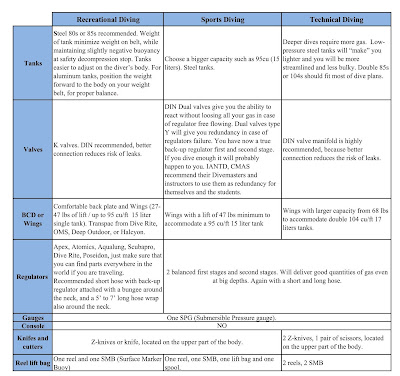
The main recommendations to a good gear
configuration are:
- Redundancy
- Streamlining
- Accessibility
- Comfort Let's see the differences between Recreational, Sport and cave diving (Technical diving configuration)
The Author personal configuration:
- Low Pressure Doubles 85's gives me plenty of gas for most of my diving, an Aluminum plate with a "purist" harness mounted on a Dive-Rite Classic wing.
- Regulators Mk 25 Scubapro with S-600 and G-250 second stages for the easy fixing on the spot works very well in warm to temperate water temperature since I do not dive cold water much.
- First regulator on the right post connected with a long hose and a MP hose for my dry suit connection. Most of people will have the MP dry suit inflation on the left post.
- Second regulator with shorter hose attached with a bungee around my neck, with a MP hose connected to my wing inflator.
Advantages for me of MP Dry suit hose on the right:
- If one of the first stage fails, that would probably be the one I use most, the one with the long hose. (happens to me twice in 20 years of teaching) in that case if i must isolate that regulator, I will not lose my BCD but only my Drysuit. I like to be able to keep my buoyancy without having to disconnect hoses.
-If I have a roll-off cave diving, and I have developed a bad habit of not checking my left post enough, I should be able to see it, because I'am using my power inflator more than my dry suit inflator at depth.
- I like to use both regulator during the dive, specially on deep dive where my primary regulator would work better if I do not ask him to much. Breathing and adding gas in the wings may sometime be too much, even if today's regulators are pretty efficient at depht I follow the "Eggs principles". Do not put them all in the same basket.
Once again there is different ways of configuring the Equipment, as we can see on the Essentials video. The main idea is to know why we use a system instead of of the other. This is one of the valuable way of thinking I have learned with my different cave mentors from the NACD, NSS/CDS and IANTD. what works for you may not work for me because humans are different in theirs habits and way of thinking.
Keeping an open mind about gear configuration Part 1
Cavern and Intro-to-Cave Primary Equipment The
basics of a good foundation are inherent to the quality of the material or
tools that are used in the building of that foundation. Gear configuration is
one of the tools that will shape a cave diver career.
Gear
configuration is an essential topic. This is basic for all cave training.
Remember what we talked about on our last “Tips and Technique” column. 2013 Underwater Speleology The journal of the cave Diving Section of the National Speleological Society NSS/CDS
“Gear configuration is an important factor. Remember your
training. Look around and ask other divers why they use a specific type of
equipment or configuration. Be open-minded.”
We need the best possible tools to do
the perfect job. If I visualize a cave diver in the 80’s the gear set was
limited to the basics. The equipment is probably safer today but divers in the
past paid more attention on what they had, and I am sure it was taking long
hours to get the best on their gear configuration set up. Given the fact that
gear donned was minimal, streamlining was commonly and easily achieved. So
let’s go back to the minimum gear requirements for Cavern, Intro Cave and Cave Diving
dives.
Practice in a pool or in a confined Water, with your equipment helps to understand it better. (see IANTD Essentials Recreational Scuba Diver video gear removal practice)
The main recommendations to a good gear
configuration are:
Steel Tanks 80s or 85s
are recommended; the weight of the tank will minimize the weight on the belt,
while maintaining slightly negative buoyancy at your safety decompression stop.
These tanks are also easier to adjust on the diver’s body. If you choose
aluminum tanks, you will have to position the weights forward of the body on
your weight belt, for proper balance.
Valves
DIN valves are highly recommended,
because they allow a better connection that reduces the risk of leaks.
BCD
It is a good practice
today to use wings and harness such as Transpac from Dive Rite, or a standard
aluminum back-plate with wings such as OMS, or Halcyon. The advantages are
enormous: it is easier to attach the pressure gauge with large D-rings and you
will have better horizontal position swimming underwater.
Regulators and Hoses
Well maintained regulators are fine, I
would go with the main brands such as: Apex, Aqualung, Atomics, Dive Rite,
Poseidon, Scubapro, and make sure that parts will be available when traveling.
I will recommend a short hose with a back-up regulator attached with a bungee
around the neck, and a 5‟ to 7‟ long hose wrapped also around the neck.
Gauges and Console
One SPG (Submersible Pressure Gauge) is
a good idea. I suggest removing the plastic cover on the SPG itself that has a
tendency to keep moisture in, even if it protects the SPG from shocks; it then
becomes easier to see and control leaks.
Personally I do not like consoles. They
are too bulky - even the smaller ones. Also, in case of an emergency, the diver
needs both hands, so they can easily have access to control their depth and
stop time. I strongly recommend wearing everything on the wrists.
Knifes and cutters
Cutting devices are very important pieces of equipment, small and located on the harness or waist strap. would
recommend Z-knives, which are easier to use with one hand and they cut almost
everything (monofilament, cave-line, nets, etc.)
We would use the same basics but we
will add and dual first and second stage as seen in picture.
Original Article was published in the Volume 40 Oct/Nov/Dec/ 2013 Underwater Speleology The journal of the cave Diving Section of the National Speleological Society NSS/CDS
We have already talked and shared opinions on Rebreather diver's check list, I believe this is something that we must emphasize and remind ourselves and people the importance of it. I still today see so many Rebreather divers rushing with the manufacturer checks and being complacent with their personal check. A Scuba diver has many responsibilities before jumping in the water. We know that one should be mentally and physically fit, and that the equipment should be set for the "mission". This is what we learned from our Technical diver courses. It also means being able to use and reproduce the skills acquired; the rebreather diver's check list is one of them and part of the solution to reduce CCR divers complacency.
We all know that an airliner pilot who has been flying for years keeps going over basic checklists before take off. So it is one of the main responsibilities for a CCR diver to follow the check list recommended by the manufacturer and by the diving agency.
The IANTD Essentials program work on 4 different control points:
1) Manufacturer's check list:
Even if it seems that some of the points mentioned on the manufacturer's check list are redundant, I trust the manufacturer, who knows the machine pretty well. There is a reason behind a check list. Let's just follow it! Megalodon manufacturer has made a detailed pre-dive and post-dive check list that helps the Megalodon diver to control and pinpoint issues before they happen underwater.
2) Agency check list:
Agencies like TDI,IANTD, PADI and probably others have developed a check list for their divers, it is a pedagogical tool that can help the diver detect changes after the manufacturer's check list has been completed. If we follow the agency philosophy and use their material, let's do it completely and use the tools created by professionals trainer who know student's mistakes and errors.
3) Personal check list.
Just before jumping in the water, I call it a "personal survival check list", every individual is different, and it is important to develop a personal muscular memory with one's unit by controlling our equipment on land. Recheck primary and secondary equipment, such as valve opening, manual O2 addition, automatic diluent valve open and functioning, safe partial pressure of oxygen in the loop, BCD inflate and deflate... It helps the diver to review his equipment and confirm that he has all what he needs for the dive.
4) In water-check.
Cave divers have been using these techniques for a long time. Check for leaks and others detectable problems that we can only be detected in the water. Bail-Out first and second stages regulators, primary and back up lights must be checked in the water, dive buddies must check for leaks tant can appear on tanks valves, first stages regulators, pressure gauges, hoses connections, dry-suit inflation.
"In order to sustain training, divers
must be able to “do something about something,” or remaining instrumental in
their own lives. As divers we must realizethat
no one else can act on our behalf, and that no one can think for us, practice
for us, or react for us. To help us develop a factually-based sense of
instrumentality, we will start by devising an outline that draws on individual progress.
Our plan of the first steps seems obvious- they are: reflection, motivation, planning, and training.
However, the last step, repetition, is
often set aside- to the diver’s detriment. Building an initial plan of action
around the concepts mentioned above may serve to reduce accidents and increase
diver safety". IANTD Essentials manualGeorges Gawinowski
The rebreather diver responsibility is to eliminate problems related to their CCR unit through a methodic practice, and by setting a good example for the community.
Technical
diver education, and mental training In a new series of blogs, we are going to think, talk, and evaluate about instructor and diver's behavior in today's society. Can we keep jumping from course to course without getting enough experience and practice between scuba diver courses? Can we participate in classes where time spent with the instructor and number of dives may get shorter and shorter? If we believe on the statement above, we also can believe that we have missed some important pedagogical points, in our training as a diver, instructor, or instructor trainer. We ought to evaluate what we are doing, without culpability, and maybe change things for the better, we all can improve our techniques and our behavior as a diver or professional. We just need to recognize our mistakes and correct them. I am sincerely confident that we know whether we are doing a good job or not either in our training, teaching, and/or dive planning .
- Technical diver education and mental training- The Training "Trap"- The Path to self-sufficiency- To a new education?
Technical diver education and mental training
Discussing about diving
preparation and diver’s self-sufficiency, we have noticed that the lack of
self-awareness in the matter along with a poor stress and risks management are often
hidden causes of scuba diving accidents and fatalities.
As the diver requirements become stronger about the choice of a diving school
that provides with adequate training and
adapted to the diver personality, other requirements are also to be considered. When it
comes to choosing diving gear to comply with technical, comfort and aestheticism criteria. We believe that the diver should be in the same way
exigent with dives preparation.
Tools to help with diver preparation:
1) Personal evaluation: physical and mental, Am I ready to make that dive today? How do I feel about that dive?
2) Motivations: Am I focus on the dive's objectives? What are my sincere motivations for that dive?
3) Responsibility: What are my personal and my team responsibilities? Is it a "solo team" dive? or is it a "team diving as a team" dive?
4) Equipment needed: do we have what we need? For the dive and in case of an emergency?
5) Emergency scenario review and land drills practice: especially when diving on a rebreather.
6) Pre-dive preparations: like athletes a Technical diver should get ready physically and mentally, and should be focused. It is a good idea for the team to warm-up with some stretching techniques, rest the mental with some breathing exercises and visualization techniques.
7) Land drill practice with check-list followed by in water safety drills, where last gear and buoyancy adjustments are made before the dive.
Most of the cave divers are pretty familiar
with a well-detailed pre-dive technique preparation routine. Technical diver agencies are pushing
this way, but this is not always the case with recreational divers, and sometime forgotten by experienced technical or cave divers!
“Safety is
our concern”.
To be continued.....
Georges Gawinowski @ WDT dive facility in cave country live-oak, Florida.
This is the time for the good resolutions for 2015, where we could incorporate in-water training skills in our physical and mental fitness routine.
The evidence is that in diving in general, and specialized areas
of diving such as technical or cave diving, and even recreational diving,
physical training is strongly associated with mental training. Training refers to the regular and
sustained practice of designed skills and exercises that increase the diver’s
capacity to perform at his or her level. The need to perform in-water drills
and absorb knowledge is present in all forms of diving. The difference lies in
the actual skills and information needed, and how to incorporate such skills
into muscle memory. Sadly, divers often consider fairly regular “pleasure”
diving with no emphasis on skills and drills as sufficient enough to maintain
his or her training level.
However scuba diving, like all athletic activities, requires
constant training and skills repetition to maintain competency.Although divers do not “compete” on a
playing field against other divers, they definitely “compete” with Mother
Nature and have to adjust themselvesto the underwater
world, an environment not suited to the human body.To accomplish this task, divers must reduce certain “stress
factors” such as feelings of discomfort or insecurity in the diving environment,
factors which, if improperly managed, can lead to a total loss of control.
I believe that 10 to 15 minutes before or after each dive could be enough to improve our technique. Reviewing emergencies skills such as bail-out from a Rebreather, repeating hyperoxia, hypoxia, situations and working on different rescue scenario with buddy. That should be fun, right!




 Posts


